If you think the Minnesota abduction raids are about combating fraud as the administration says, you are wrong four hundred times over.
The fraud most often cited to justify these actions in Minnesota is the Feeding Our Future case. That case involved roughly two hundred fifty million dollars in fraudulent claims tied to a COVID era emergency child nutrition program. It was serious. It was criminal. And the people responsible should be held accountable.
But context matters, especially when fraud is being used to justify aggressive enforcement actions and sweeping political narratives.
Federal watchdog agencies estimate that fraud connected to the Paycheck Protection Program nationwide totaled between sixty four and one hundred thirty five billion dollars. Taking the midpoint of that range puts the estimate at roughly one hundred billion dollars. Compared to the Minnesota case, that means PPP fraud was approximately four hundred times larger.
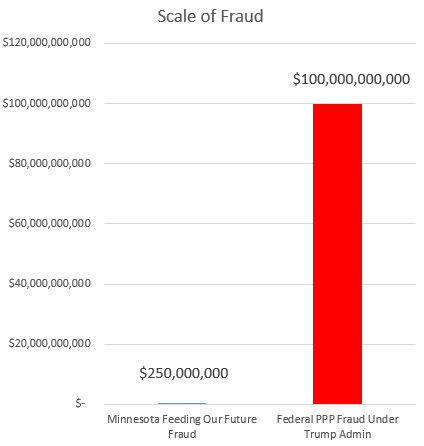
This is not a marginal difference. It is not a rounding error. It is an entirely different scale of failure.
The PPP program was designed, launched, and almost entirely disbursed under the first Trump administration. It was created during an unprecedented crisis, and it was intentionally structured to prioritize speed over safeguards. Those design choices were not accidental. They were openly discussed and defended at the time as necessary to move money quickly into the economy.
Federal inspectors later concluded that those same design decisions dramatically increased the risk of fraud. The money was pushed out through private lenders with limited verification, minimal upfront checks, and weak oversight mechanisms. Once the funds were distributed, recovery became difficult or impossible in many cases.
Both the PPP fraud and the Feeding Our Future fraud originated during COVID emergency programs. Both exploited relaxed rules. Both involved criminal actors taking advantage of a system under stress. The difference is not moral. It is structural.
PPP was a federally designed and federally administered program, issued through private banks, spread across every state. Responsibility for its vulnerabilities is diffuse and shared across Congress, federal agencies, lenders, and the administration that designed it.
Feeding Our Future, by contrast, was administered at the state level. Oversight failures were concentrated within a specific agency. That concentration makes the case easier to localize, easier to narrate, and easier to weaponize politically.
When enforcement rhetoric and public outrage focus narrowly on a single state level fraud while largely ignoring a vastly larger federal fraud, it creates a distorted picture of where the most significant failures actually occurred. It suggests that the issue is geography or local governance rather than program design and crisis era decision making.
Fraud during COVID was widespread. It occurred in red states and blue states. It occurred in federal programs and state administered programs. It occurred because systems were rushed, safeguards were weakened, and enormous sums of money were moved quickly in an emergency.
If the goal is genuine accountability, fraud prevention, or protecting taxpayer dollars, then discussions should reflect scale, structure, and context. They should address why the largest fraud in modern American history occurred, what design choices enabled it, and how those choices can be avoided in the future.
Selective outrage does not accomplish that. Using smaller cases as political symbols while treating vastly larger failures as background noise does not protect the public. It obscures the real lessons that should be learned.
If this were really about fraud or saving taxpayer money, the largest fraud in United States history would not be treated as a footnote.
Disclaimer: This post reflects my personal views and analysis based on publicly available information and official reporting available at the time of writing. It is an opinion and commentary piece, not legal or financial advice. This post was AI assisted in research, drafting, and editing. Any errors are unintentional, and readers are encouraged to consult primary sources.
 Charlie's Place